Whether the goal is to restore perfect concentricity in a forged drive shaft or to eliminate stress distortion in a welded assembly, precision depends on understanding how the material behaves under force. Forged and welded components may share similar shapes or performance requirements, but their internal structures, stress patterns, and mechanical responses are completely different. Forged shafts offer strength and uniformity due to consistent grain flow, whereas welded assemblies combine multiple materials and stress zones that respond differently under load. Understanding these variations in the workpiece and applications enable precision straightening.
How Workpiece Structure Influences Behavior
No two parts behave the same under load. How a workpiece was formed, joined, and machined influences its unique structural characteristics, which determine how it responds to straightening forces. Forged shafts and welded assemblies may share dimensional targets, but their material structure and stress profiles differ dramatically.
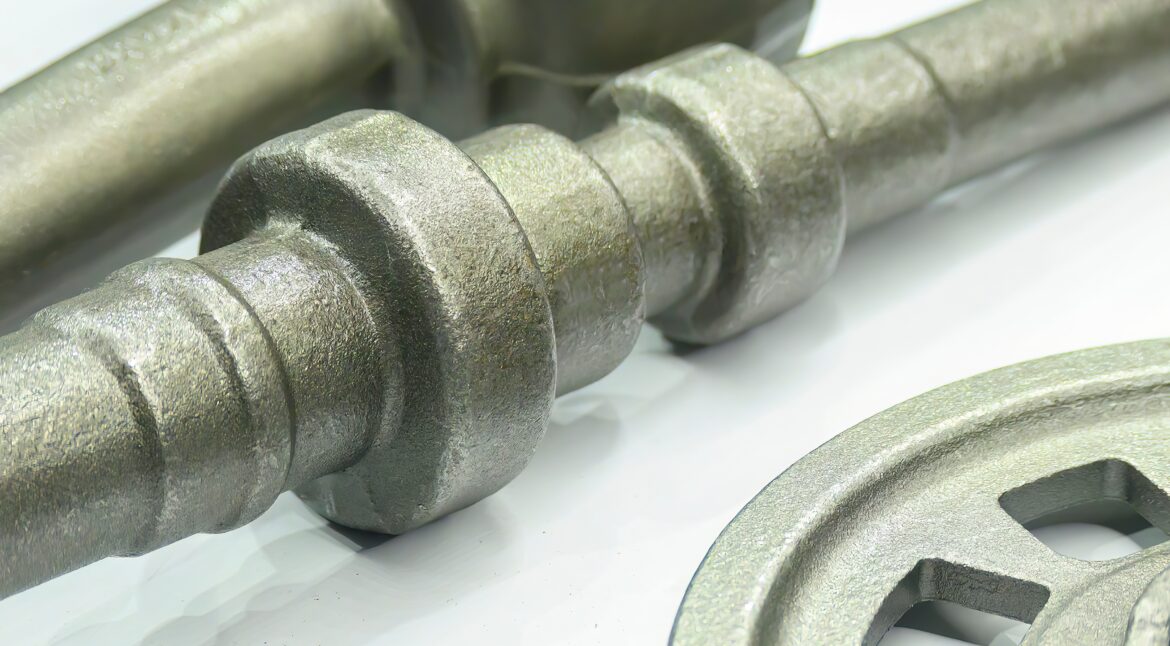
Forged shafts exhibit a continuous grain structure that conforms to the part’s shape, offering exceptional strength, fatigue resistance, and dimensional stability. However, the forging process also introduces internal stresses that can cause distortion during machining operations. Welded assemblies, on the other hand, are created from multiple components with different material properties. Each weld joint introduces localized heat-affected zones and residual stress, resulting in an inconsistent structural signature that can react unpredictably during load application.
Recognizing these behaviors is the first step in selecting the correct straightening setup for the workpiece and applications. What works for a homogeneous forged component may not deliver the same results on a welded frame or bracket.
Geometry, Deflection, and Control
Beyond material properties, geometry and dimensional length play a key role in how a part deflects. Long, slender forged shafts require high-precision support and rotational accuracy to maintain true straightness. Even a small amount of misalignment can multiply along the length of the workpiece, resulting in unacceptable runout. Welded assemblies present a different challenge. Their non-uniform stiffness can cause deflection to occur in localized areas rather than across the full part length. Maintaining consistent straightness requires multi-axis control and adaptive fixturing that can compensate for asymmetrical load paths.
Straightening Systems Tailored to Every Workpiece and Its Applications
In straightening operations, slight variations in geometry or stiffness can have a significant impact on how a part responds to pressure. The contact points, the way the part is supported, and the distribution of load across the geometry all determine how effectively and safely the material can be corrected. The key to achieving consistent, repeatable straightening lies in the right tooling and fixturing strategy.
Advanced Tooling and Fixturing Capabilities
Every workpiece behaves differently once force is applied. A forged shaft, for example, may resist bending uniformly along its length, while a welded assembly might yield or flex in localized regions depending on joint configuration and weld thickness. Static fixturing can’t always accommodate these differences, leading to overcorrection, surface marking, or residual stress.
Adaptive Tooling: Adaptive tooling compensates for these factors in real time. By allowing supports and clamps to self-align with the part’s true centerline and surface contour, MAE-Eitel’s fixturing systems maintain consistent contact and even pressure distribution. This prevents point loading, improves accuracy, and reduces the number of correction cycles required to achieve tolerance.
Dynamic Fixturing: Many modern workpieces and applications, such as welding frames or assemblies, incorporate complex geometries that shift the part’s center of gravity or create irregular load paths. Conventional straightening setups may require multiple reconfigurations to achieve proper alignment, increasing cycle time and variability. MAE-Eitel’s modular fixturing kits address this challenge with precision-engineered components that can be adjusted, swapped, or repositioned to suit the specific workpiece application.
Integrated Control Systems: Adaptive tooling and dynamic fixturing work together with the machine’s advanced measurement and control systems. As deflection sensors record the part’s response to the applied force, the system automatically adjusts both pressure and fixture positioning. This closed-loop interaction between the tooling and control system ensures the correct straightening moment is achieved without overstressing the material.
Matching the Machine to the Material
MAE-Eitel’s automatic straightening machines are engineered to adapt to those differences with modular and interchangeable tooling kits built for specific geometries and metallurgies. Servo-controlled pressure points, integrated measuring systems, and real-time feedback loops ensure each workpiece receives precisely the amount of correction needed. With specialized tooling kits, intelligent control systems, and application-specific fixturing, they deliver consistent accuracy across a full range of metallurgies and part geometries without overstressing the material or compromising surface finish.
Selecting the right straightening solution isn’t about force capacity alone—it’s about aligning machine design with workpiece and application requirements. Forged shafts demand uniform load application, high rigidity, and precise linear measurement. Welded assemblies require flexibility, localized control, and multi-axis adaptability. MAE-Eitel delivers both.
MAE-Eitel Straightens It Out
Whether your components are forged, welded, or a combination of both, MAE-Eitel provides the technology to bring every workpiece back into perfect alignment. Contact us today to learn more.