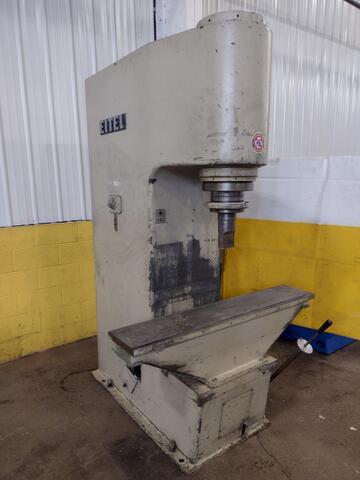
Industrial straightening machines are designed for decades of service, but even the best MAE-Eitel machines eventually show signs that they need modernization. As production demands increase and tolerances become tighter, an older straightening machine can struggle to meet today’s expectations for speed, accuracy, and repeatability. Understanding the indicators early helps prevent unnecessary scrap downtime and costly failures while keeping your straightening line performing with the consistency your operations depend on.
6 Shop-Floor Signals that Your Straightening Machine Needs an Upgrade
Knowing when your straightening machine is due for an upgrade or retrofit is critical for protecting uptime, maintaining quality, and controlling operating costs. If you’re seeing any of the following signals on your shop floor, it may be time to take a closer look at the condition and capability of your straightening machine.
1. Inconsistent Straightness or Flatness
One of the earliest warning signs that straightening equipment is degrading is a machine that used to deliver precise, high-quality output now produces inconsistent results from one run to the next. Most often, varied output is the first sign of worn tooling, alignment drift, and aging controls, all of which are easily addressed with an equipment upgrade.
2. Operators Constantly Making Manual Adjustments
If your operators spend more time tightening bolts, or re-aligning the setup than actually running production, the machine is no longer holding its settings reliably. Excessive manual intervention is a sign that core systems are wearing out or are no longer capable of holding tolerance. By upgrading control systems and replacing worn components, downtime is minimized.
3. Frequent Minor Breakdowns or Recurring Issues
Intermittent issues, such as premature bearing wear, hydraulic leaks, and control system glitches, tend to escalate as the machine ages. What starts as minor downtime often becomes chronic, signaling deeper component fatigue and the need for systemic repair or modernization. Addressing the core cause of these problems through upgrades or retrofitting may be the most cost-effective option.
4. Declining Throughput and Rising Scrap Rates
Declining throughput is often tied to mechanical wear, falling hydraulic pressure, and control inaccuracy, all signs that your machine isn’t performing at its original capability. As mechanical accuracy fades and controls lag, production rates drop, and the hidden cost of outdated equipment becomes harder to ignore. Jobs that once ran at a predictable pace begin slowing down as scrap, rework, and maintenance costs creep higher.
5. New Noises or Rough Operation
If operators are complaining of unusual noises or rough operation it’s time to listen. These problems arise when the hydraulic system is compromised or there’s a mechanical issue inside the gear box, and signal the need for immediate action. Once operators notice unusual sounds, production efficiency is already compromised. If left uncorrected, total equipment failure will follow. Likewise, if switching between runs becomes increasingly difficult, the machine may simply lack the responsiveness and flexibility modern production requires.
6. Safety or Compliance Concerns
Aging straightener machines often struggle to meet current safety requirements. Older straighteners may carry outdated guards, worn components, aging electrical systems, or obsolete safety interlocks. If internal audits or third-party inspections flag these issues, the machine is no longer just inefficient—it’s unsafe. Once safety becomes a concern, a retrofit or replacement becomes a necessity, not an option.
Bonus Signal: Growing Beyond What the Straightening Machine Was Built For
Even well-maintained equipment can become outdated when your operation grows. You may be processing thicker materials, higher-strength alloys, tighter tolerances, or simply more volume than before. When increased production demands outpace the machine’s capabilities, upgrading becomes a strategic opportunity.
Risks of Delaying Retrofit or Replacement
Aging machinery rarely fails all at once. It declines gradually, and the longer it runs in that state, the more it affects your productivity and profitability. Postponing upgrades may feel cost-efficient in the moment, but it often leads to larger, more disruptive issues. At some point, maintaining an outdated machine becomes more expensive than bringing it up to modern standards.
Delaying too long can result in:
-
- > Lower-quality output — more scrap or rework, which reduces profit margins.
-
- > More downtime and unpredictable breakdowns disrupt production schedules.
-
- > Increased maintenance costs, both in parts and labor, often rise non-linearly over time.
-
- > Safety hazards for operators if components fail, controls misbehave, or structural integrity is compromised.
- > Competitive disadvantage: inability to meet tighter tolerances, new material types, or higher throughput demanded by modern orders.
When Replacement Is the Most Cost-Effective Option
As discussed in our recent post When Do Industrial Retrofitting and Conversions Offer a Better ROI on Straightening Equipment?, retrofitting or converting an existing straightening system can often extend its lifespan and deliver excellent return, provided the base machine design remains viable. However, there are clear scenarios where retrofit or conversion is no longer sufficient. In these cases, investing in a brand-new straightening machine from MAE-Eitel becomes the most cost-effective choice.
-
- > Critical parts are no longer supported.
-
- > Control systems are too outdated for meaningful upgrades.
-
- > Structural wear limits the machine’s ability to hold tolerance.
-
- > Retrofitting approaches the cost of a new build.
-
- > Your production requirements now exceed the machine’s design specifications.
Let The Experts at MAE-Eitel Help You Straighten It Out
Whether you’re troubleshooting recurring issues, considering a retrofit, or planning a full equipment replacement, MAE-Eitel brings decades of engineering expertise to every straightening application. Our team can evaluate your straightening machine, diagnose the root causes of performance loss, and recommend the most cost-effective solution, from targeted upgrades to complete new systems.
Ready to restore accuracy, uptime, and dependable straightening performance?
MAE-Eitel is here to help you straighten it out. Contact us today.