When industrial straightening equipment becomes obsolete, whether it’s a fully automated system or a simple manual press, replacing it with modern technology is expensive and labor-intensive. However, operating inefficient machines in today’s environment also increases costs, labor requirements, and risks. Smaller, family-owned companies often face a disadvantage, lacking the necessary liquid assets to invest in advanced technologies, and risk losing their competitive edge if they don’t. Except in certain circumstances, industrial retrofitting and conversions offer fabricators an accessible option to upgrading legacy equipment without the heavy capital investment.
How Smart Manufacturing Improves Industrial Straightening
Smart manufacturing combines advanced human-machine interfaces (HMIs), digitized programmable logic controllers (PLCs), and sophisticated sensor technologies to enhance throughput, efficiency, accuracy, and repeatability. In industrial straightening operations, these systems and technologies work together to improve operator safety and machine performance, reducing scrap and rework rates. The most advanced equipment requires little to no operator intervention as robotics and automated systems handle everything from raw material storage and retrieval through production and into packaging for delivery. Especially with full IoT capabilities, which enable automated straightening equipment to connect with the operations’ internal network and allow for real-time data exchange, monitoring, and remote troubleshooting.
Industrial Retrofitting and Conversions of Legacy Equipment
When regularly maintained and repaired by expert technicians, MAE-Eitel industrial straightening presses provide consistent, accurate results for decades, with some legacy models still in prime operating condition after 50 years. Their robust design and heavy-duty construction allow them to continuously meet specifications under extreme operating conditions. Due to their extended lifespan, these machines can survive through multiple technology generations. With the spread of advancements, even a ten-year-old automatic straightening machine can be considered obsolete. Machines from the early 2000s simply cannot keep up with the speed, performance, and safety of newer models.
While it’s unlikely that industrial retrofitting and conversions can bring a 10- to 20-year-old machine up to full Industry 4.0 specifications, upgrading legacy straightening machines can help smaller shops bridge the gap.
-
- Upgrading electrical control panels with more efficient components, for example, helps reduce energy consumption, lowers operating costs, and may qualify for valuable tax credits.
-
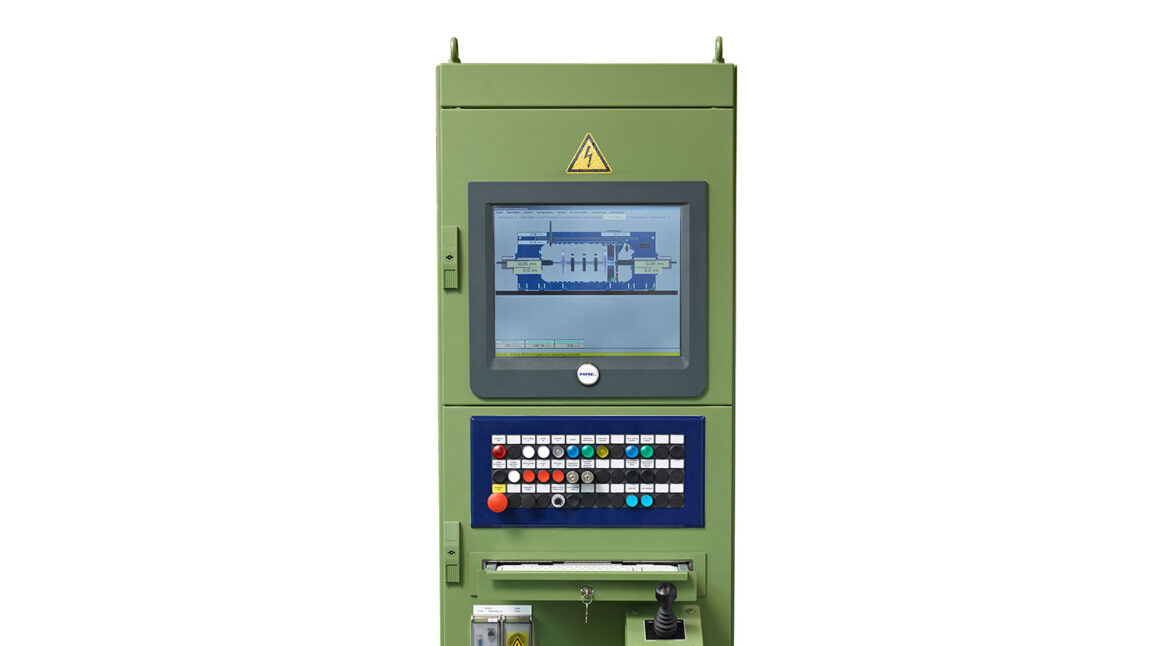
- Replacing dial and switch controls with advanced touchscreen HMIs can drastically reduce rework and scrap rates while improving throughput.
-
- Integrating newer sensors and semi-automatic processes has the potential to improve operator efficiency and safety.
-
- Some automatic straightening machines from MAE-Eitel may also be compatible with IoT technologies and remote troubleshooting.
Custom Solutions to Keep You Competitive
One of the biggest advantages of industrial retrofitting and conversions is the ability to develop customized solutions tailored to your specific processes, workflows, and application needs. Contact the experts at MAE-Eitel today to learn more.