In 2026, American manufacturing faces a unique paradox: demand for precision metal components continues to grow, as does the demand for onshoring, while the workforce that makes such products continues to shrink. It’s no surprise that automation has become the central theme across industry headlines and tradeshows alike.
In many cases, automation is about reducing labor costs, improving quality, and increasing production speed. However, for many domestic manufacturers, the shift towards automation isn’t just about efficiency, it’s about survival. With understaffed factory floors, automation is often the only way to keep operations running.
We had a look into some of the recent industry data. While exact numbers vary, roughly 80% of manufacturing leaders cite skilled labor shortages as their biggest challenge heading into 2026, with more than 400,000 open manufacturing jobs across the United States. For shops processing bar stock, tubing, and profiles, this workforce gap creates a critical bottleneck in operations that directly affects production capacity and delivery timelines.
The traditional answer of simply hiring more operators obviously doesn’t work in all cases. Many shops simply can’t find enough local talent, while looking at an aging skilled workforce, with more folks retiring every year. For most of the shops we work with at Mae-Eitel, the question isn’t whether to automate, but how to implement automation that delivers immediate operational value without requiring extensive operator training or additional headcount.
The Hidden Labor Cost Within Manual Straightening Processes
Many fabrication shops underestimate the true labor investment in metal straightening operations. Manual straightening machines require skilled operators to measure runout, determine correction points, and apply controlled force. These are specialized tasks that demand years of experience to execute consistently. A single operator may spend 15-30 minutes even for a relatively simple workpiece. Then the process must be precisely repeated for every bar, tube, or profile entering production.
Beyond the direct labor hours, manual straightening tends to introduce more variability than automated processes. Different operators apply different techniques. Quality depends on individual skill levels and level of fatigue. Training new employees on manual straightening systems can take months before they achieve consistent results. When that experienced operator retires or moves to another position, the institutional knowledge leaves with them.
That labor intensity creates compounding problems. Most shops either wind up with a bottleneck in production at the straightening stage, or they have to pull skilled workers from higher-value tasks to address material prep. As you’re probably aware, neither solution scales effectively in today’s constrained labor market.
Automatic Straightening Machines Free Up Your Workforce
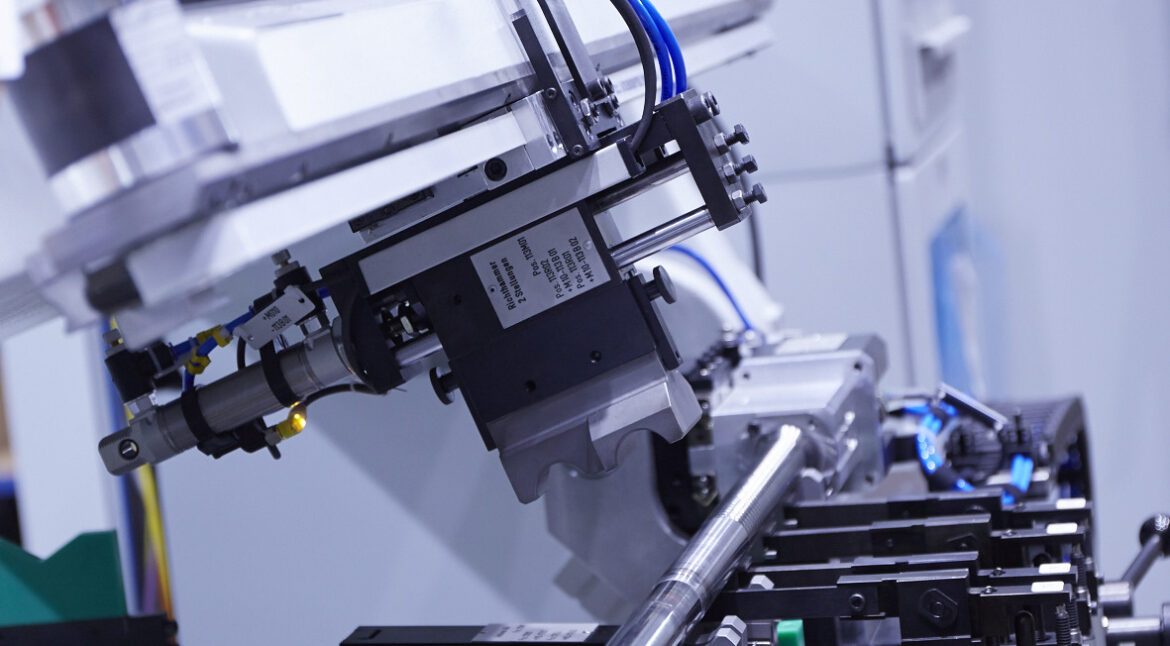
MAE-Eitel automatic straightening machines fundamentally change the labor equation by removing operator skill as a variable. These systems use servo-controlled automation integrated with intelligent measurement technology to straighten bar stock, tubing, shafts, and profiles without human intervention beyond loading and unloading.
It’s a precision process that operates through continuous sensing and correction. Sensors measure runout at multiple data points along the workpiece length while the material rotates. This data feeds directly to the PLC, which calculates optimal correction points and indexes a servo press along the workpiece to apply controlled bending force exactly where needed. The system then re-measures, verifies specification compliance, and repeats correction cycles until all data points fall within tolerance. You’ll typically achieve straightness within 0.02” over the entire length.
This closed-loop automation offers three major advantages to your workforce:
- –The machine essentially operates independently once material is loaded, freeing operators for setup, inspection, or other value-added activities.
- –Automation eliminates the experience curve. A new hire can load material and monitor the system with minimal training.
- –Our automatic straightening machines produce consistent results regardless of operator skill level, shift changes, or production volume fluctuations.
Maintaining Production Capacity with a Smaller Workforce
Our automatic straightening systems don’t entirely replace manual labor, but dramatically accelerate throughput per operator. Industry data shows automated straightening reduces cycle time by 60-80% compared to manual methods. What previously required 20 minutes of skilled operator time now completes in 4-6 minutes with minimal supervision.
For many simpler tasks, a single operator can now oversee straightening operations that previously required three workers. In other cases, that operator can manage straightening alongside another process, effectively consolidating multiple roles without compromising quality or safety. Smart automation means maintaining production output even as your crew size shrinks.
Faster cycle times and streamlined manufacturing processes also help you with downstream labor constraints. Precision-straightened components minimize setup time for other machining processes, as well as tolerance issues and the risk for production errors. Your operators spend less time troubleshooting vibration problems, less wasted cost scrapping parts that deviate from specification. The entire production chain becomes more efficient so you get maximum value from your existing workforce capacity.
Adaptability Without Programming Expertise
A common concern we hear from manufacturers considering new investments in automation is the perceived need for specialized programming knowledge. That’s another scarce skill set in today’s labor market. MAE-Eitel straightening systems address this through artificial intelligence integration that automatically adapts to material variances without operator intervention.
When material hardness varies, diameter changes, or incoming straightness differs from typical stock, the system’s AI algorithms adjust correction parameters in real time. Your operator doesn’t need to understand PLC programming, calculate optimal bend points, or modify process variables. The machine learns and compensates automatically, maintaining consistent output quality across material lots and suppliers.
This adaptive capability has significant workforce implications for your facility. You don’t need to hire or train automation specialists to run straightening operations. Your existing production personnel can operate the system effectively, and your supervisors don’t need engineering backgrounds to troubleshoot basic issues. The technology barrier that typically accompanies automation adoption essentially disappears, making implementation feasible even if you have limited technical staff.
Rethinking Your Workforce Allocation Beyond 2026
As you navigate sustained labor shortages, strategic resource allocation becomes increasingly essential to your profitability. Every skilled operator represents a finite capacity that must be deployed where human judgment, adaptability, and expertise create the most value. MAE-Eitel automatic straightening machines enable this strategic redeployment by handling a labor-intensive, repetitive process with precision that matches or exceeds manual methods.
Forward-thinking fabrication shops are reconsidering which processes truly require human intervention versus which can be automated without quality compromise. Straightening falls squarely in the automation-ready category. The process follows predictable physics, requires consistent force application, and benefits from the repeatability that machines deliver naturally.
By automating straightening with MAE-Eitel equipment, you can reserve your limited workforce capacity for complex setups, quality inspection, process optimization, and customer-specific customization. After all, these are the activities where human skill and expertise genuinely differentiates competitive performance. Our machines have the precision straightening processes covered.