Straightening jobs aren’t always straightforward. Sure, correcting a simple shaft or bar stock is manageable with your more basic (or even outdated) manual straightening systems. But when you’re dealing with geometrically complex workpieces like camshafts, turbine blades, surgical implant components, and other precision components, any margin for error practically disappears.
In these and many other complex applications, manual straightening methods often aren’t enough to keep up with tight tolerance and production requirements.
Those are the types of jobs where high-precision automatic straightening machines become indispensable in the modern production line. Serving manufacturers throughout the automotive, aerospace, medical, and industrial sectors, MAE-Eitel has spent decades developing automated straightening systems that don’t compromise between precision and throughput.
Below, we lay out the advantages and applications from customers using our automatic straightening machines for manufacturing programs that deal with exceptionally complex workpieces.
The Challenge with Complex Workpieces
Complex workpieces present a set of problems that basic straightening equipment simply isn’t built to handle. Variable cross-sections, tight tolerances, asymmetric geometries, and delicate surface finishes all demand a level of control that manual or semi-automatic systems struggle to deliver consistently.
- –Automotive manufacturers producing crankshafts, driveshafts, and steering components face this daily. A crankshaft, for example, has multiple journals and counterweights distributed along its length. Correcting runout on one section without introducing stress or distortion elsewhere requires precise force application at specific points, not a generalized press stroke.
- –Aerospace component manufacturers often deal with even tighter tolerances, often working with high-strength alloys and finished surfaces that cannot be reworked after straightening. In these applications, precision is critical.
- –Likewise in the medical device space, straightening a bone screw blank or an orthopedic rod to within a few microns is non-negotiable, both for regulatory compliance and patient safety.
How MAE Meets These Challenges
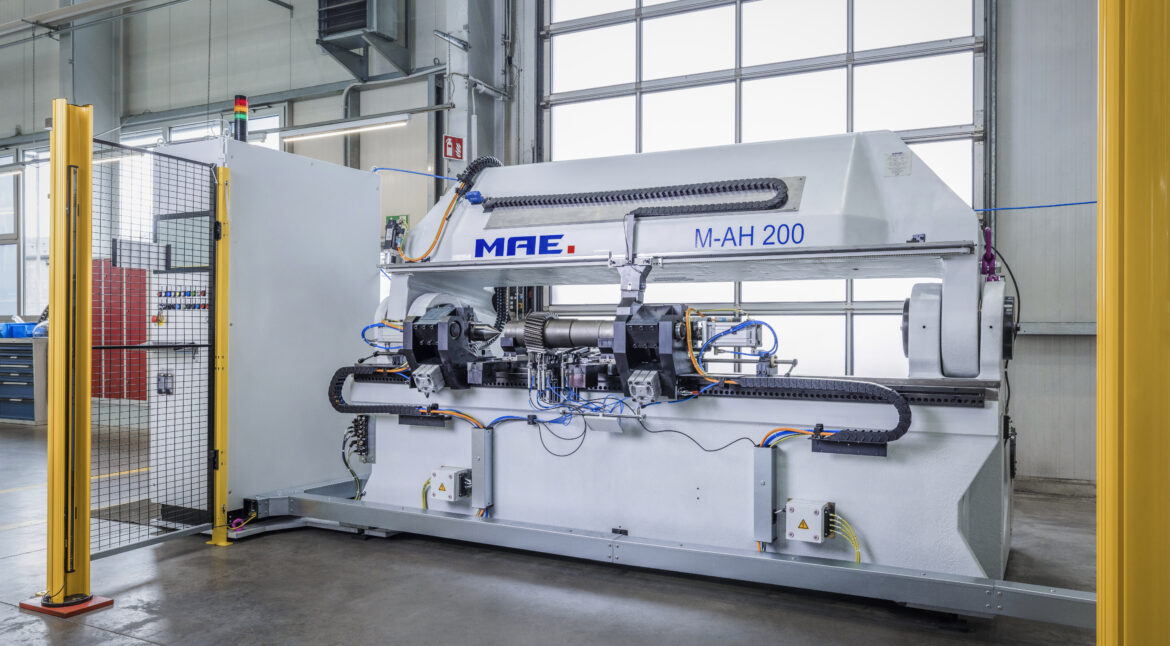
MAE-Eitel automatic straightening machines are engineered around the reality that no two complex workpieces behave identically, even within the same production run. Our systems use closed-loop measurement and correction cycles that continuously monitor part geometry and adjust press force accordingly.
The process works like this: the workpiece is loaded, either manually or via automated handling, and placed between precision support rollers or fixtures. High-resolution measurement probes assess the actual runout or bow along the part’s full length. The machine’s control system calculates the required correction at each straightening point and applies force with exact repeatability. After each press stroke, the part is re-measured and the cycle continues until the workpiece falls within the defined tolerance band.
This approach eliminates the guesswork that plagues manual straightening and dramatically reduces the risk of over-correction, which can be just as damaging as leaving a part out of tolerance. For high-value components like aerospace forgings or machined medical implants, that level of control is what makes the difference between a good production run and a costly scrap pile.
Automation Integration for High-Volume Production
Precision alone isn’t enough when you’re running thousands of parts per shift. MAE-Eitel designs its automatic straightening systems to integrate seamlessly into automated production environments. Robot-compatible loading and unloading interfaces, conveyor integration, and communication protocols that talk to your existing MES or SCADA systems are all part of the package.
For automotive suppliers operating under just-in-time delivery schedules, this level of integration is critical. The straightening cell becomes part of the flow rather than a bottleneck. Cycle times are optimized, part handling is minimized, and data from every straightening operation can be logged for quality documentation and traceability. That last point matters increasingly to customers in regulated industries, where demonstrating process control is as important as the parts themselves.
Serving Manufacturing Operations Across Industries
Over the years, we’ve worked closely with manufacturers across automotive, aerospace, medical, and general precision machining sectors. What consistently comes up in those conversations is the same core problem: customers have invested heavily in upstream machining and finishing operations, and they need a straightening step that doesn’t undo that investment.
Over the years, we’ve worked closely with manufacturers across the automotive, aerospace, medical, and precision machining industries. While their applications may differ, the same challenge consistently arises: companies invest significantly time and resources into machining, heat treating, and finishing operations, and they need a straightening process that protects that investment.
When parts feature tight tolerances, complex geometries, or critical surface finishes, straightening can no longer be treated as a secondary operation. It must be performed with the same level of precision and control as the manufacturing processes that came before it.
That’s the engineering challenge we’ve built our systems around, and it’s why customers who process complex workpieces at scale keep coming back. When you combine accurate measurement, responsive force control, and smart automation, straightening stops being a problem and starts being a competitive advantage.
If your operation involves complex workpieces and you’re evaluating whether your current straightening process is keeping pace, get in touch with our experts to talk about what MAE-Eitel systems can do specifically for your production line.