At Mae-Eitel, we’ve worked with many manufacturers who currently only use manual straightening machines, wondering if their operations and volume levels justify the investment in automated straightening systems.
Obviously, that conversation is going to be unique to every different manufacturer. So really, the only short answer is: It depends on your specific production needs. Nevertheless, we wanted to put together a basic guide that will help you understand the fundamentals of manual vs. automatic straightening machines.
From there, we’re happy to continue the conversation or look specifically at your needs.
Manual Straightening: Better ROI for Many Smaller-Scale Projects
We see manual straightening machines are the workhorses of small and mid-sized manufacturing operations across the nation. Despite the limitations, manual systems are even preferred in a number of production scenarios, specifically in high-mix/low-volume projects.
Manual straighteners give operators direct, hands-on control over the process, which is exactly what you need when you’re working with low-volume runs, prototype parts, or components with unusual geometries that don’t fit neatly into an automated workflow.
Our manual straightening machines are built for precision and durability, and they put your most experienced operators in the driver’s seat. When you have a skilled technician who understands how a shaft or rod responds to pressure, manual control can actually deliver excellent results. There’s real value in that tactile feedback loop.
Manual systems also carry a lower upfront investment, which makes them the right starting point for many shops. If you’re running a few dozen parts per shift, or if your mix of part types changes frequently, a manual machine may be all you need.
Manual Straightening Starts to Show Its Limits as Volume Increases
As production volume starts to increase, manual straightening introduces a set of challenges that compound quickly.
Speed is the first constraint. A skilled operator can only straighten so many parts per hour, and that rate doesn’t scale. When a customer needs thousands of shafts straightened per week to meet delivery commitments, manual throughput simply can’t keep up without adding headcount and floor space.
Consistency is the second issue. Even the best operators have variability in their results. Fatigue, shift changes, and subtle differences in technique all introduce variation. For industries where tight tolerances are non-negotiable, such as automotive, aerospace, or precision fluid handling, that variability creates risk. It shows up in scrap rates, rework time, and parts that fail downstream inspection.
The third challenge is documentation and traceability. Modern manufacturers increasingly need to demonstrate process control. Manual operations are difficult to document with the level of detail that quality systems require.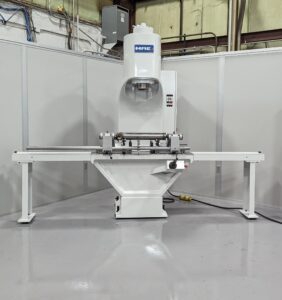
Automated Straightening Systems Help You Achieve Scale
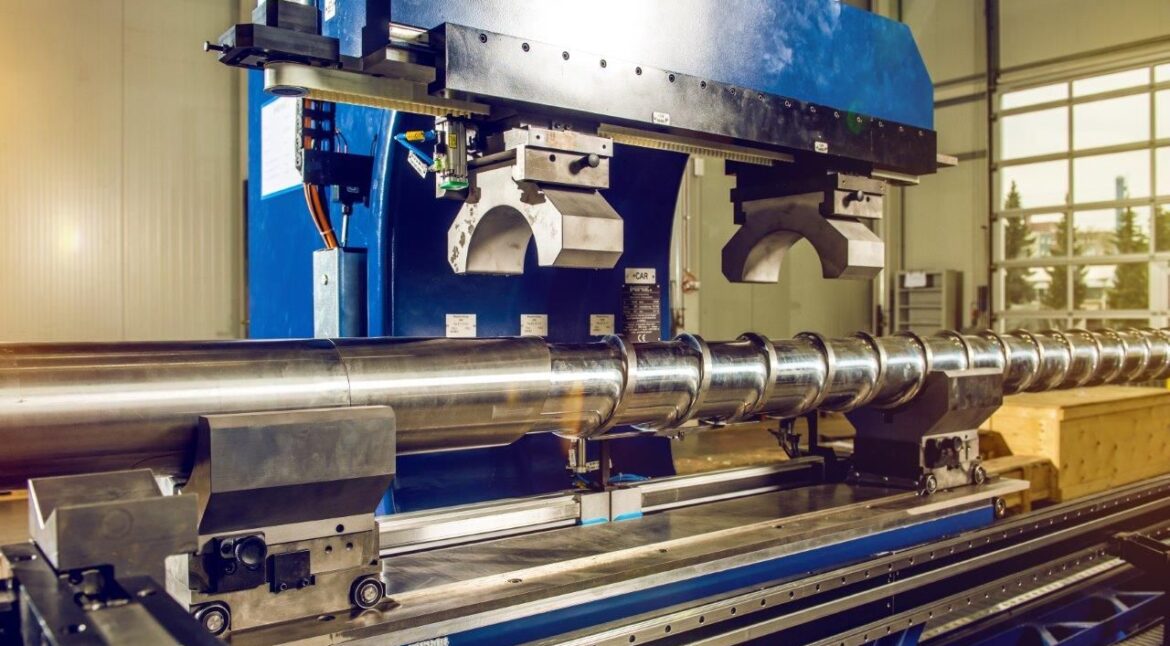
Our automatic straightening machines are designed specifically to address these pain points at scale. They measure part runout, calculate the correction needed, apply the precise straightening force, and verify the result in a closed-loop process. The operator doesn’t need to guess or rely on feel. The machine handles the decision-making.
The throughput difference is significant. Automated systems can process parts at a rate that simply isn’t achievable with manual methods, and they do it consistently across every shift. Whether you’re running the first part of the day or the five-hundredth, the process is the same.
Repeatability is where automation earns its keep on the quality side. When you’re holding tolerances in the range of a few microns, machine-controlled straightening eliminates the human variable from the equation. That directly reduces scrap and rework, which translates to real cost savings.
Automated systems also generate process data. Every cycle can be logged, giving you the traceability that quality audits and customer requirements increasingly demand.
How to Think About the ROI Decision
The question we hear often from owners, operators, and production managers is: how do I justify the investment? The answer comes down to an honest look at your current production numbers and where you’re headed.
-
- Start by calculating your true cost per part under manual straightening. Factor in labor hours, scrap rates, rework, and any throughput bottlenecks that affect your delivery performance. Then model what those numbers look like if volume doubles or triples.
- Next, think about the value of consistency. If a single out-of-tolerance batch causes a line stoppage at a customer’s facility, the cost of that event often exceeds a significant portion of the capital investment in automation.
- For manufacturers running high volumes of similar parts with consistent geometries, the ROI case for an automatic straightening machine tends to be straightforward. The payback period shortens as volume increases, quality costs decrease, and your operation becomes more competitive on delivery and reliability.
- For lower-volume or highly varied production, a manual machine remains a smart, cost-effective choice.
The right answer is the one that fits your production reality. If you’re not sure where you fall on that spectrum, our team at Mae-Eitel is happy to walk through your application and help you figure out which approach makes sense for your operation today and as you grow.